Explainer · Clause 2.6 · Technology with a light footprint Clause text
Technology that leaves the river alive
Why the Society links lasting happiness to a healthy environment, what it means by eco-technologies, and whether caring for nature puts the brakes on progress.
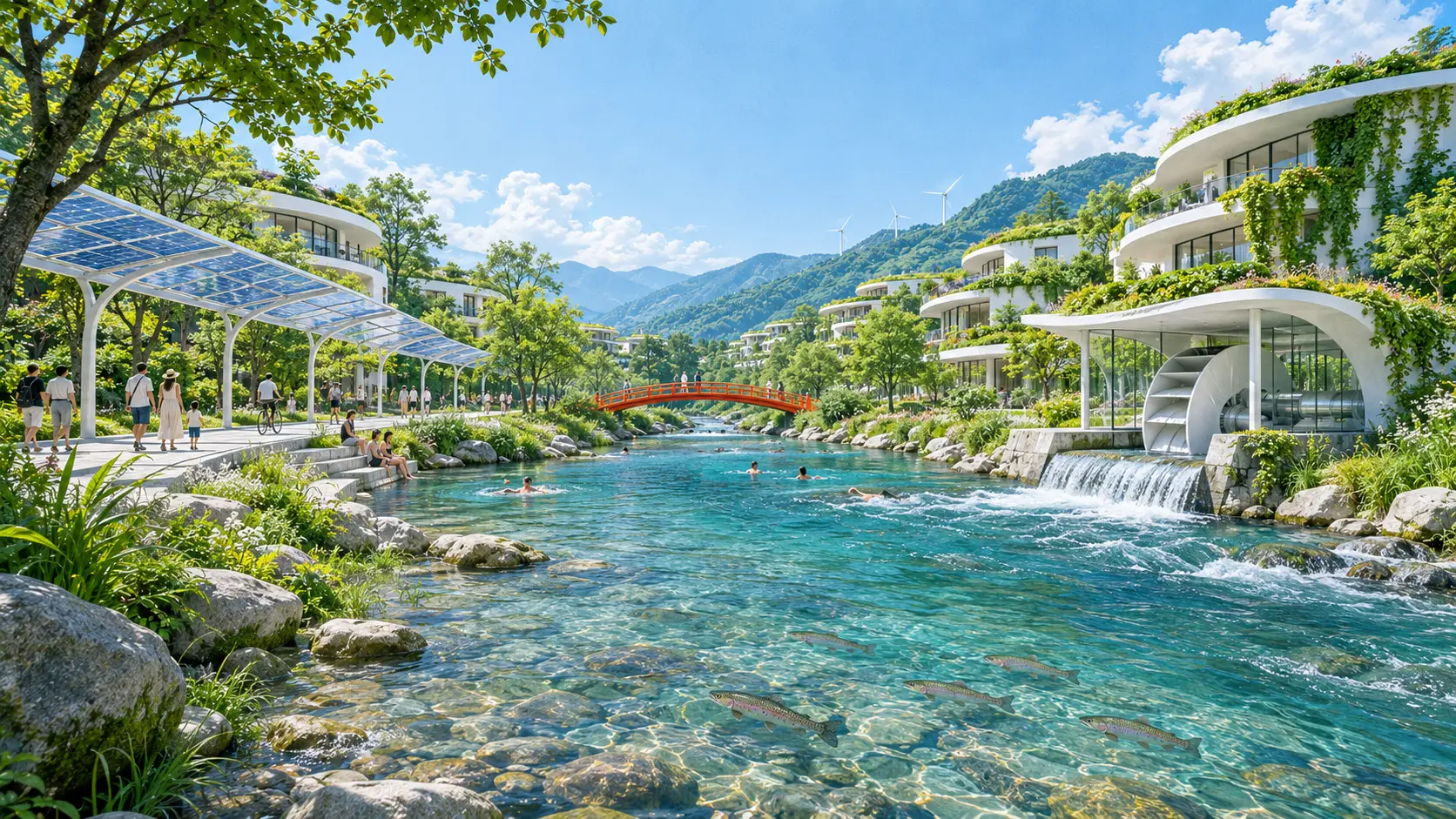
Every summer you go back to the river where you swam as a kid. This year there’s a new sign on the bank: “No swimming.” A factory has gone up upstream. It makes something useful—maybe something you use every day.
At home, the kettle breaks. It’s two years old, and repairing it would cost more than buying a new one. Off it goes to the landfill, following the one before it.
Every new thing makes life a little easier, and nearly every one takes something from the world that life plays out in. The bill comes later, and everyone pays it.
What the clause says
Clause 2.6 is a single line, and it sets out both a direction and a goal.
The Society develops eco-technologies with minimal environmental impact to maintain ecological sustainability.Technology with a light footprint
Put simply: the Society keeps developing, and technology remains its main tool. The clause gives that technology a direction. Every technology is designed from the outset to leave as small a footprint on nature as possible. The goal is ecological sustainability: the water, air, and land around us stay healthy for the long haul, decades into the future.
The Society’s commentary stresses that the clause is about the direction development takes, and it gives eco-technologies a precise description.
- Eco-technologiesas the Society’s commentary describes them
Technologies designed, right from the drawing board, as part of nature’s cycles. They fit into nature, follow its laws, and sustain life and the resources it depends on.
The key phrase here is “right from the drawing board.” A filter on an old factory’s smokestack is a patch: first the harm appears, then someone works out how to reduce it. An eco-technology works differently. Care is built into the design itself, the way a forest turns its fallen leaves into soil for new trees.
Two paths of development
You can see the difference between the two paths in ordinary things.
| The usual path | The path of Clause 2.6 |
|---|---|
| Make it convenient first, then figure out how to undo the harm | Care is built into the design from the drawing board |
| A thing works until it breaks, then heads to the landfill | A thing gets repaired and upgraded, and its materials go back into use |
| Solving one problem creates two new ones | Technology solves the problem, and the environment stays healthy |
| Clean rivers and living forests are for vacations and photos | Living nature is close at hand, part of an ordinary day |
| Progress is measured by speed and today’s profit | Progress is measured by how people live decades from now |
For a person, the main payoff of this path is peace of mind. The Society’s commentary names it directly: confidence in tomorrow, because the environment around you stays clean and balanced.
In everyday life, the idea behind the clause looks almost mundane. When you buy something, you know it will be repaired and, later, put to use again. When you visit the river, you know that people coming thirty years from now will swim in it too. Convenience stops being a deal your health pays for later.
Why people need it
The Society’s commentary derives this clause from the Society’s central goal: the happiness and development of every citizen (Clause 1.2). The logic fits into four steps.
The goal is happiness that lasts for years, not for a season. Happiness like that needs a solid foundation, and one of the most important is a healthy environment: it’s hard to be truly happy where the air is hard to breathe and there’s nowhere to swim. The way to protect that foundation is technology with minimal impact. The result is a sustainable society, where everyone’s happiness rests on firm ground. Hence the idea that runs through the whole clause: damage the environment, and you undermine your own roots.
The clause has a second job, too: it joins two of its neighbors. Clause 2.1 promises continuous development; Clause 1.14 promises harmony with nature. On their own, they could pull in different directions: development needs resources, and harmony asks us to conserve them. Eco-technologies turn the two into a single strategy, in which development sustains and strengthens the natural world that people remain a part of. Beyond the Society, Clause 4.4 carries the same line forward: the Society pursues sustainable development together with other societies.
This is a choice citizens make together. The commentary calls it a considered decision about the best way toward a shared goal, and development priorities are set jointly, by consensus and direct vote (Clause 2.9).
A brake on progress?
Say “eco-technology,” and many people picture pricey “green” products that work worse than the usual kind. That’s where the most common doubt comes from.
Think back to the river at the start. The factory saved on water treatment, so its product came out cheaper. The river paid the difference, along with everyone who used to swim there.
Try it on for size
The easiest way to try Clause 2.6 on for size is with the things around you at home.
Some would start with a phone, some with clothes, some with the whole kitchen at once. What matters is the shift in perspective: the thing becomes part of a cycle, and its journey continues after you.
Here is what in the clause is already settled, and what still lies ahead.
- Value
- Citizens’ lasting happiness is tied to the health of the environment they live in (Clauses 1.2 and 1.14).
- Value
- Development and care for nature are a single strategy: technologies are designed to leave a light footprint and sustain the life around them.
- Value
- The direction was chosen consciously and voluntarily; citizens set development priorities together (Clause 2.9).
- Desired future
- Technologies that fit into nature’s cycles: things last a long time, their materials go back into use, and the water and air stay clean.
- Desired future
- An environment where living nature is part of every day, right outside your door.
The Society’s commentary ends with a question that sums the clause up well: what kind of world becomes possible when technology serves harmony rather than consumption?