Explainer · Clause 2.7 · Virtual worlds as places for experience Clause text
Virtual worlds you come back from stronger
Why the Society is developing virtual reality, how a world built for creativity, learning, and rest differs from the feed on your phone, and what the word “additional” is doing in the clause.
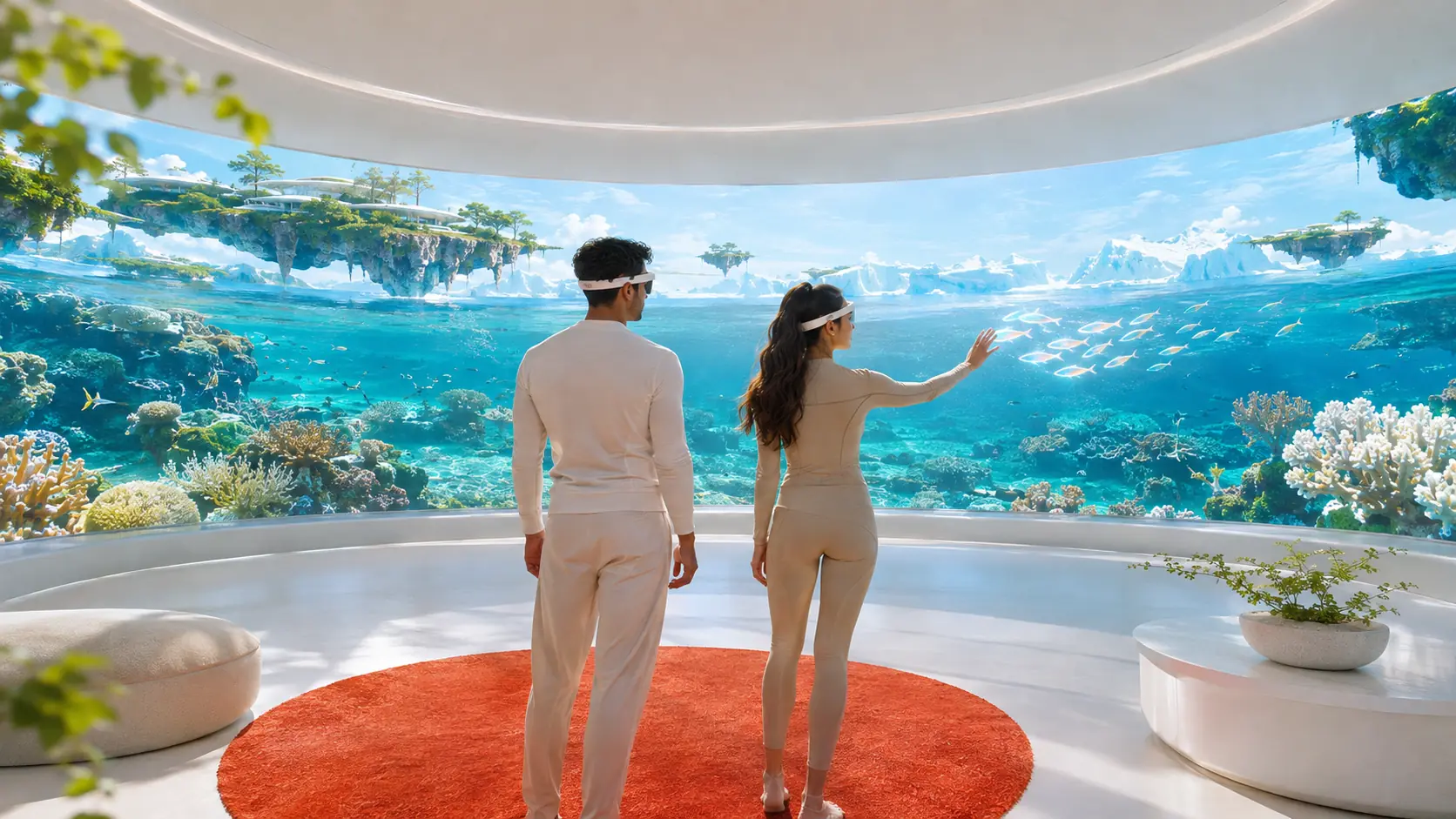
In the evening, you pick up your phone to unwind. An hour later you’re still scrolling, and you have less energy than when you started.
Meanwhile, the paints you bought two years ago are still waiting on the shelf. Next to them sits an old dream of walking through Rome in Caesar’s day, along with a wish to learn to speak calmly in front of people. The usual things get in the way: it’s expensive, it’s far, it’s scary to slip up in front of everyone.
The screen is almost always within reach. And almost always, it invites you to watch rather than do.
What the clause says
Clause 2.7 is longer than its neighbors, and nearly every word in it adds something.
The Society develops virtual reality technologies to create a space for creativity, learning, and leisure, fostering additional sources of enjoyment and self-development for citizens, where citizens can broaden their experience, interact with unique worlds, and explore the depths of their inner world.Virtual worlds as places for experience
Put simply: the Society is developing virtual reality for three purposes—creativity, learning, and rest. There, citizens broaden their experience, discover one-of-a-kind worlds, and get to know themselves better.
The Society’s commentary spells out the key point. Here, a virtual world is a tool with a clear purpose. You act in it: build, experiment, master skills. Rest in it restores you, and you come out with more energy than you went in with.
One word in the clause is worth noticing right away: “additional.” It sets the measure. Virtual worlds add new sources of enjoyment and growth to the life a person already has.
What it looks like
The difference from today’s screen is obvious right away.
| The screen today | A virtual world under Clause 2.7 |
|---|---|
| Watching: a movie, a feed, someone else’s life | Doing: building, trying things, changing the world around you |
| Rest is a distraction, and by bedtime you’re drained | Rest restores your attention and your emotional reserves |
| History comes from a textbook | You can walk the streets of a city from the past yourself |
| Creativity runs up against materials, money, and the fear of ruining things | Any material does what your hands want, and a failed attempt can be undone |
| Mistakes in real life are costly, so people rarely try | In a safe world, you can try as many times as you need |
The Society already has a world of its own in virtual reality: citizens meet regularly in the ETERNALS world on the VRChat platform. Below is the story of one evening.
That one evening brings together learning, rest, and what the clause calls exploring the depths of one’s inner world. The Society’s commentary describes a virtual world as a safe, controlled environment where you can study your own reactions and your own potential with nothing at stake in real life. A sandbox for the mind, of sorts.
The thinking behind it
The Society’s commentary lays out the logic of the clause step by step. First, a virtual world removes the barriers to imagination: distance, the cost of materials, the laws of physics, the price of a mistake. That creates an environment where people can create freely. In an environment like that, people recharge well. And the energy they regain opens up new dimensions of happiness and harmony.
All these steps lead to one thing: more freedom. The freedom to enjoy, to grow, to create, and to explore beyond the physical world.
The clause builds on its neighbors. The Society’s goal is the happiness and development of every citizen (Clause 1.2), and virtual worlds offer both tools for reaching it and new sources of enjoyment. Clause 1.9 promises support for each person’s unique interests and abilities: in a virtual world, even the rarest talent, cramped by the material world, has room to grow. And the neurotechnologies of Clause 2.3 are meant to sharpen attention, memory, and the speed of learning; virtual worlds would become the place where those abilities get a full workout.
An escape from reality?
The most common worry is familiar to anyone who has ever stayed up too late with their phone. If the world on the screen is brighter and simpler than the real one, why come back?
The answer starts with the word this explainer flagged at the very beginning.
Try it on for size
The easiest way to try Clause 2.7 on for size is with one of your own evenings.
Some would pick a workshop, some a walk through an ancient city, some a quiet spot by the water. All these choices share one thing: an hour like that leaves you with more energy than you started with.
Here is what in the clause is settled, what already works, and what still lies ahead.
- Value
- Virtual worlds as a space for creativity, learning, and rest that adds new sources of enjoyment and growth to a person’s life.
- Value
- In these worlds, people act, learn, and create; rest in them restores your energy.
- Value
- Whether to use them is up to each person (Clause 1.3).
- Already working
- Citizens meet regularly in the ETERNALS world on VRChat.
- Desired future
- Worlds where you can walk through a city from the past, create with any material, and safely explore your own reactions.
- Desired future
- A link with neurotechnology (Clause 2.3): the abilities it develops are trained in virtual worlds.
The Society’s commentary ends with a question worth taking with you: what horizons will open up once understanding can reach beyond the physical world?