Explainer · Clause 1.7 · Public ownership Clause text
The richer the Society, the freer each of us
Knowledge, technology, and material goods that belong to the Society as a whole and are open to every citizen: how this changes an ordinary day, why it is built this way, and what sets public property built by consent apart from property seized by force.
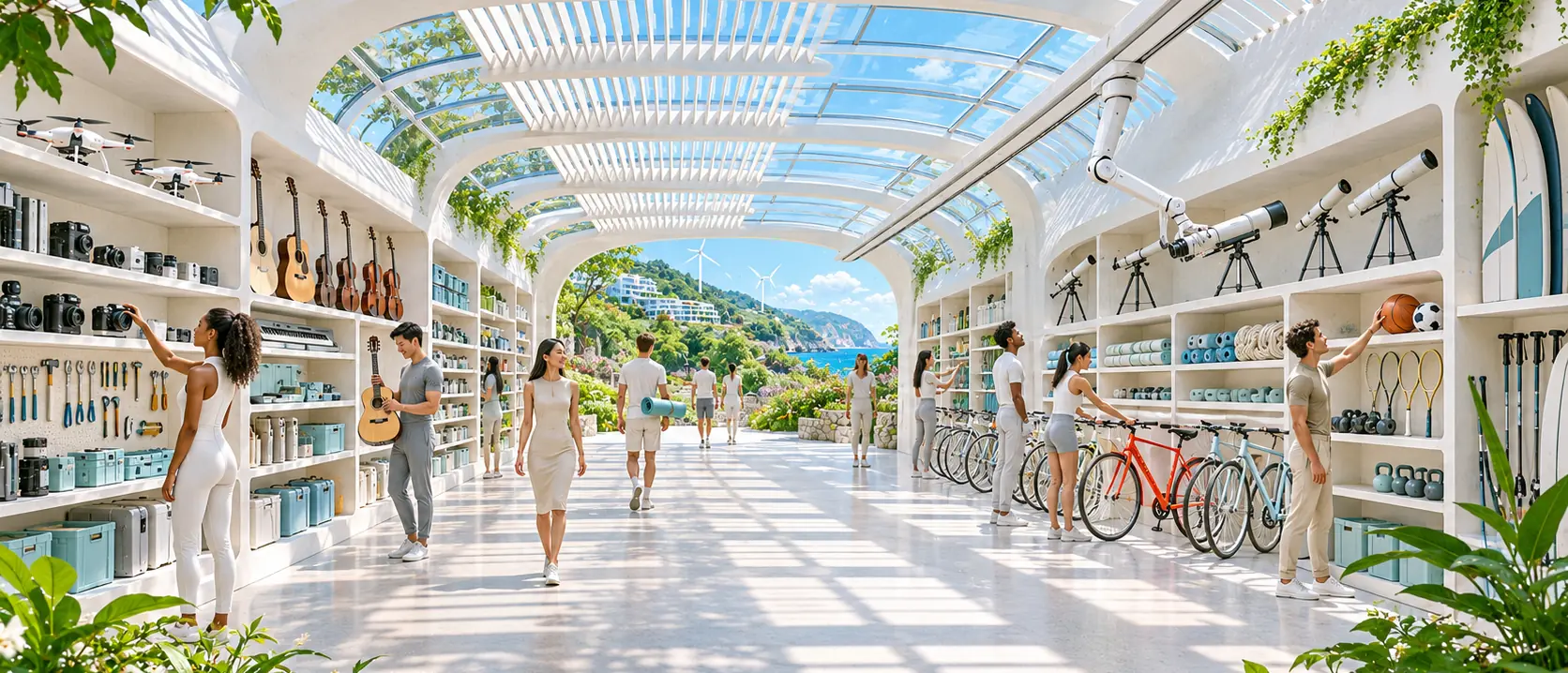
In the morning you cut through the park. In the afternoon you look something up in a free online encyclopedia. In the evening you borrow a book from the library. None of it is yours, and you use all of it easily and gladly.
Right alongside runs a different order of things. Every apartment in your building has its own power drill, and each one gets a few minutes of use a year. The course you need sits behind a paywall. An experienced coworker keeps what they know to themselves so no one can replace them.
In that order of things, a lot of energy goes into getting your own and holding on to it. Meanwhile the park, the encyclopedia, and the library show you every day that public property works.
What the clause says
The Society’s economy, and the relationships within it, rest on this clause.
The Society is founded on public ownership, under which all resources, including knowledge, technology, and material goods, are public property and are accessible to all citizens for their shared well-being.Public ownership
Put simply: everything citizens have created and built up together belongs to the Society as a whole, is open to each of them, and serves everyone’s well-being.
- Public ownership
Property that belongs to the Society as a whole and is open to every citizen. “Public” here means the Society, not a state. It differs from co-ownership, where a thing has several owners and each controls their own share. In ETERNALS all property is owned by the Wealth Fund, and a citizen holds a stake in the fund: a share of the whole, not a share in any particular thing.
The Society’s commentary names three kinds of resources. Knowledge, open to everyone with no barriers. Technology, as tools for shared progress. Material goods that provide comfort and security. The yardstick is simple: a resource is anything that helps people grow and live well.
The most personal things stay with the person. Clause 1.3 gives everyone full control over their own body and their own life. What becomes common is resources, and the common good, in the Society’s view, is the foundation for each person’s growth: the more that is open to all, the more possibilities any one citizen has.
What it looks like
You can see the difference in the most ordinary things.
| Life as you know it | Life under Clause 1.7 |
|---|---|
| You buy a home with a mortgage and pay it off for decades | Citizens receive their apartments and personal belongings for their use |
| Everyone buys their own, even things they use once a year | You take what you need from public property and return it for the next person |
| Useful knowledge sits behind fees and subscriptions | Knowledge is open to every citizen |
| People guard their expertise to stay irreplaceable | People share their expertise gladly: the knowledge already belongs to everyone |
| A new project starts with whether you can afford to begin | A new project starts with choosing what to take on |
| Who manages public property, and how, is hidden from view | Everyone can see what belongs to all and how it is managed |
Below is an ordinary Saturday in the Society.
A bookcase is a small thing. But small things like this add up to a life where people spend less time acquiring and more time making.
Why make things public
The Society’s commentary compares two ways of arranging life.
In the first, every resource has an owner, and access has to be bought or fought for. That creates artificial scarcity: the thing or the knowledge exists, but you can’t get to it because of how access is set up. Out of that grow conflicts over resources, and inequality.
In the second, whatever is created together serves everyone. The fight for access falls away, and with it a huge share of the effort that used to go into getting and keeping your own. People put that energy into creativity, growth, and shared work. That, in the Society’s view, is the core idea of the clause: to redirect energy from struggle to creation.
Knowledge shows this best. When you share what you know, you still have it, and now someone else has it too. Shared knowledge grows faster the more people use it.
Public property works in the Society’s economy too. Its foundation is the Wealth Fund, an endowment fund. The fund owns all of the Society’s property, and each citizen holds a stake in it. Private property in the Society becomes public: each citizen owns a share of everything, not directly but through their stake in the fund. Inside the Society there is no private household property and there are no mortgages. Citizens receive their apartments, personal belongings, and everything they need for life and for their work in the Society for their use.
It works like a company whose employees own part of its shares. The company issues an employee a laptop and a car: the things belong to the company, and part of the company belongs to the employee. So it pays to look after what you were given and to help the business grow. ETERNALS works the same way: the more carefully citizens treat public property and the more they create, the richer the fund in which each of them holds a stake.
The fund’s principal is kept intact: the assets are invested, and the income from them goes to public purposes. The investments are spread across different areas: cryptocurrencies, tokenized assets, businesses and startups, exchange-traded funds (ETFs), real estate, and stocks.
Clause 1.7 supports the clauses around it. Public ownership makes equality and fairness possible (Clause 1.6), along with guaranteed basics: housing, food, education, healthcare (Clause 1.8). Together they serve the purpose the Society exists for—the happiness and development of every citizen (Clause 1.2).
And the key condition: public property is built out of free choice. Joining the Society is a conscious decision made by mutual consent (Clause 1.1), and those who contribute to it are people who share these values.
Haven’t we seen this?
For many people, the words “public property” carry a heavy history, and the concern here is entirely understandable.
The answer begins with separating what was tried before from what this clause proposes.
Try it on for size
The easiest way to try Clause 1.7 on for size is with your own home and your own calendar.
Most of us pay for more things and knowledge we barely use than we realize.
Everyone’s answer is different. One person gains a spare room, another a new craft, another a kind of calm: everything needed is there, so there’s nothing to cling to.
Here is what in the clause is already settled, what already works, and what is still being built.
- Value
- Public ownership: knowledge, technology, and material goods belong to the Society and are open to every citizen for their shared well-being.
- Value
- Voluntary participation: public property is built from the choices of people who share the Society’s values (Clause 1.1).
- Value
- Citizens receive their apartments and personal belongings for their use, with no purchase and no mortgage. All property is owned by the Wealth Fund, and each citizen owns a share through their stake.
- Value
- Decisions about public property are made by consensus, and priorities are set by citizens’ direct vote (Clauses 1.5 and 2.9).
- Already working
- The Wealth Fund: it owns the Society’s property; its principal is kept intact, investment income goes to public purposes, and each citizen holds a stake in it.
- In development
- A system for tracking public property: a clear view of what belongs to everyone and how to manage it.
- Desired future
- Abundance, where the energy that once went into fighting over resources goes into creativity, growth, and shared work.
The Society’s commentary ends with a question worth taking with you: what becomes possible, for each person and for the Society as a whole, when all the energy that used to go into the struggle for survival and resources goes into building something together?