Explainer · Clause 2.8 · Where potential comes from Clause text
Growing up where decisions are made in the open
Clause 2.8 speaks of the artificial creation of new citizens with high potential. What “high” means here, where that potential comes from, and how the Society answers the question of whether this is eugenics.
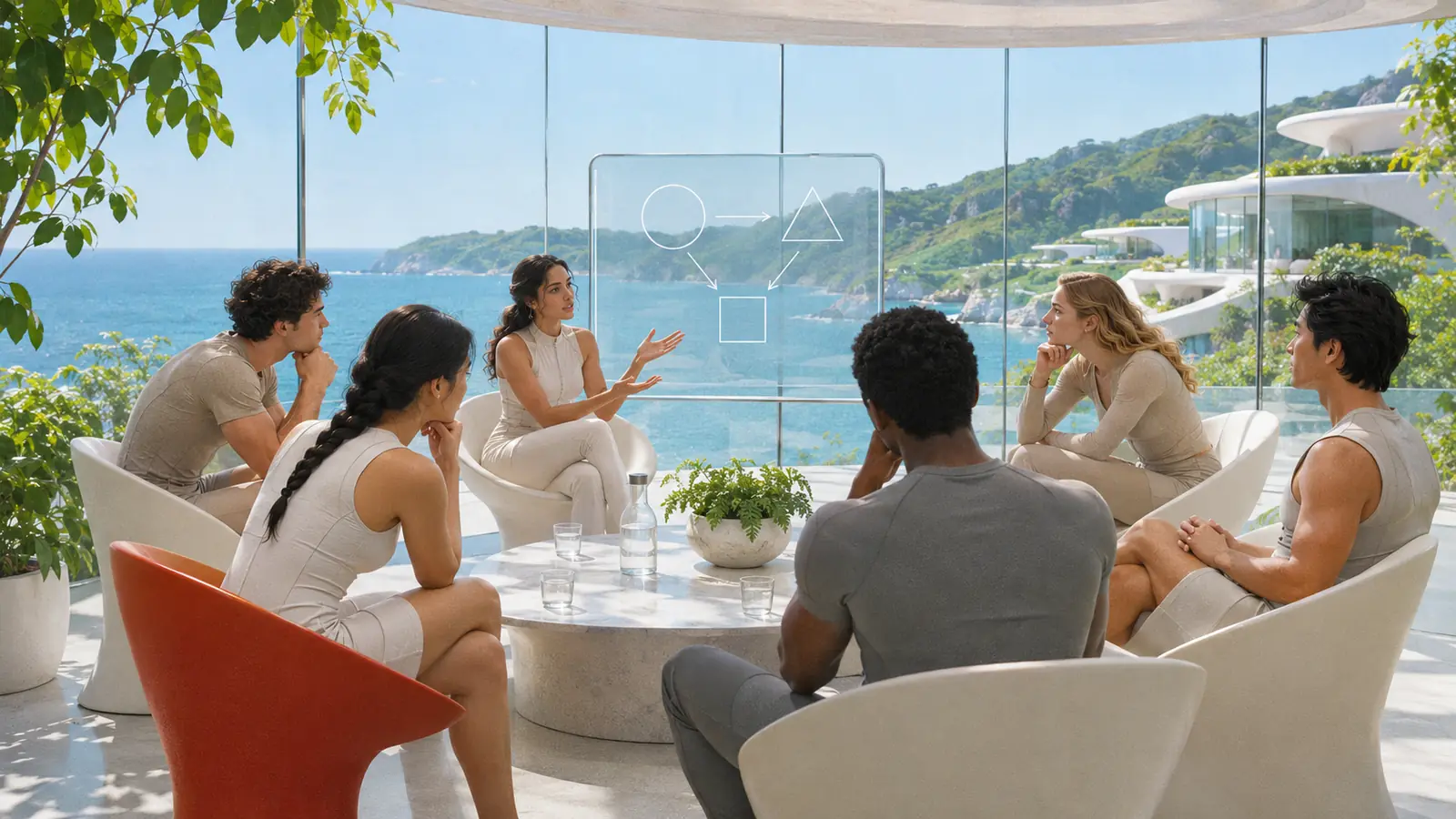
You probably had a classmate who was great at drawing. By seventh grade, they drew only on the back page of their notebook and covered it with one hand so no one would laugh. Another kid asked lots of questions and soon figured out it paid to keep quiet.
As adults, many of us keep doing the same work. We guess what the boss really wants. We play defense in meetings. We look for the catch in an acquaintance’s offer. By evening, there’s little energy left for the things we wanted to do for ourselves.
People spend more energy on survival than they notice. And it starts long before their first job.
What the clause says
Clause 2.8 is one of the sharpest in the Constitution. It says outright that the Society develops technologies for creating new citizens.
The Society develops technologies for the artificial creation of new citizens with high potential for intellectual, moral, and physical development, which contributes to the general welfare, harmony, and sustainable development, and also maintains a balance between population size and available resources.Where potential comes from
Put simply, the clause holds three ideas.
The first: the Society develops technologies for creating new citizens artificially. These are technologies of the future and a goal the Society is working toward.
The second: these new citizens have high potential for development in three dimensions at once—intellectual, moral, and physical.
The third: why this is needed. According to the clause, such people strengthen the general welfare, harmony, and sustainable development, and creating them helps keep a balance between the number of people and the resources the Society has.
The most important question in the clause is what “high” means. The Society answers it this way.
- High potentialas the Society understands it
Potential greater than that of a person today who grew up in a competitive and aggressive environment, where much of their energy goes into survival. The source of this potential is the environment: a person is born and raised where decisions are made consciously, openly, and without hidden agendas.
The baseline here is an ordinary person in today’s world, and the difference comes from the conditions a person grows up in. The classmate with the drawings had the talent from the start. It got lost in an environment where hiding paid off.
Two environments for growing
Most of us know both environments, at least secondhand. What sets them apart is where a growing person’s energy goes.
| An environment of survival | The environment of Clause 2.8 |
|---|---|
| Energy goes into holding your ground and protecting yourself | The basics are covered, and energy is free for learning, work, and people |
| Adults decide behind closed doors, and you’re left guessing at their motives | Decisions are made openly, and even a child can see the reasons behind them |
| Hidden agendas all around, so a child learns to be sly | Straight talk all around, so a child learns to speak plainly |
| Disputes go to whoever is stronger or craftier | Disputes are settled peacefully, through agreement with everyone |
| Your start depends on where, and to whom, you were born | From day one, everyone has the best opportunities open to them |
That’s also one way to read the three dimensions of potential named in the clause. Intellectual potential grows when a child’s energy goes into questions and learning. Moral potential grows when, from their earliest years, a child sees decisions made openly, peacefully, and with respect for everyone, and comes to take that as normal. Physical potential grows when health, food, and care for the body are provided from the very first day (Clause 1.8).
Where such people grow up is described in the neighboring Clause 1.13: in specialized community institutions that offer the best conditions for development. This path is voluntary: citizens remain free to have children themselves.
The Society’s reasons
The Society’s commentary on the clause gives two reasons.
The first is the common good. Every new citizen who grows up with high potential becomes a creative force, adding to the well-being of everyone around them and to shared harmony. In short: how each person turns out shapes life for everyone.
The second is balance. Today, population size takes shape on its own, and society then scrambles to catch up with schools, hospitals, and housing. Clause 2.8 matches the number of people to the Society’s resources, so that everyone has what Clause 1.8 promises: education, healthcare, food, clothing, and housing. Otherwise, the commentary says, an imbalance is inevitable, and it undermines both each person’s happiness and everyone’s stability.
Both reasons rest on the same idea. The commentary on the neighboring Clause 1.13 calls it a shift from chance to conscious design: a new person’s potential depends on an environment prepared in advance, rather than on whatever circumstances they happened to be born into.
Is this eugenics?
The words “creating new citizens with high potential” bring one association to many minds. It’s an understandable one, and the concern deserves to be taken seriously.
The key difference comes down to two questions: who decides, and where the potential comes from.
Try it on for size
The easiest way to feel this clause is through your own life story. Think about where your energy went as a child, beyond learning and play: reading the adults’ moods, holding your own among other kids, hiding your mistakes. Then make the same estimate for your adult life: how many hours a week go into defense, guesswork, and double-checking.
Now imagine that from your very first day, you were surrounded by adults who made decisions openly and explained them, and that food, housing, school, and health were taken care of.
Everyone’s answer is different. That gap is exactly what the Society means by “high potential.”
Here is what in the clause is already settled, and what still lies ahead.
- Value
- High potential is understood in terms of environment: a person grows up where decisions are made consciously, openly, and without hidden agendas, and their energy is free for growth.
- Value
- Everyone controls their own body and life, and force and coercion are prohibited (Clauses 1.3 and 1.4). Citizens remain free to have children themselves.
- Value
- A balance between population and resources, so that everyone has enough in the way of education, healthcare, food, and housing (Clause 1.8).
- Intention so far
- Citizens make decisions about creation technologies together: development priorities are set by consensus and direct voting (Clause 2.9).
- Desired future
- Technologies for the artificial creation of new citizens with high potential for intellectual, moral, and physical development.
- Desired future
- An environment where a child grows up, from the very first day, surrounded by open and conscious decisions (Clause 1.13).